Science Introduction
A film-industry-facing introduction to Signature Theory, identity alignment, and the central rule that makes the world work.
Watch the introduction →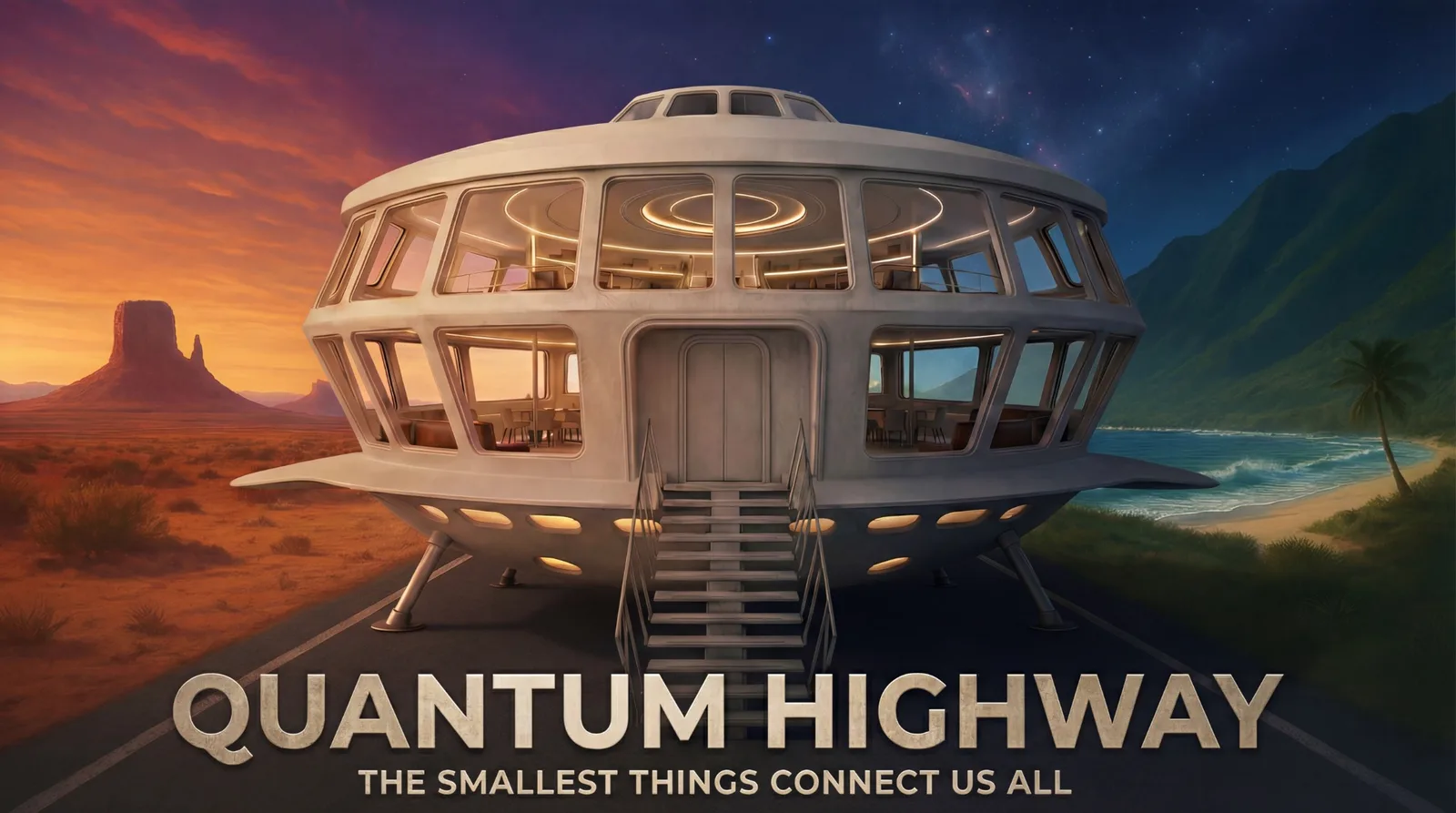
An original, character-driven science-fiction adventure by Canadian creator, screenwriter, and world builder Stu Webster, built around a single rule-based idea: identity, not distance, determines connection.
A completed science-fiction script and franchise opportunity available for representation, option, acquisition, development, and production review.
Conceived, directed, assembled, and edited by Stu Webster, with AI-assisted image, animation, voice, and music tools used in the production workflow.
A film-industry-facing introduction to Signature Theory, identity alignment, and the central rule that makes the world work.
Watch the introduction →A cinematic proof of concept for the film’s character-driven adventure, grounded humour, visual language, and scale.
Watch the story preview →A personal invitation from the creator explaining why the project was built and what kind of partnership it is seeking.
Watch the closing film →When a struggling astrophysicist follows an impossible signal to a Nevada garage, he meets a self-taught engineer who has unknowingly proven his theory of connection across time—forcing them to confront a discovery where even the smallest moment can ripple forward to reshape the future.
Dr. Tom Calder is an underfunded North Shore astrophysicist whose career is disappearing with his observatory. Charlie Mercer is a self-taught Nevada inventor who has built the experiment that proves his rejected Signature Theory is real.
When Tom follows an intelligent anomaly to Charlie’s garage, they discover that her message did not merely cross distance—it arrived before it was sent. Their breakthrough draws billionaire Mason Blaine, whose need to own the discovery accelerates a chain reaction neither science nor money can control.
The film’s emotional centre is the partnership between Tom and Charlie: two people carrying loss, wonder, and the growing realization that the most important discovery of their lives may demand restraint rather than possession.


Quantum Highway uses a proprietary, audience-readable mechanic with firm limits. The science is mechanical; the story remains human.
Every object carries a unique Signature shaped by the conditions of its creation. Connection depends on identity—not a set of coordinates.
A rapid, decisive molecular transformation can create a readable physical Anchor. Without a valid Anchor, there is no destination to lock onto.
Lumma is the living interface capable of creating and stabilizing safe passage. She is not manufactured technology or an unlimited solution.
Small disturbances can cascade forward. The central question is not whether the Highway can be controlled, but whether it should be used.
The mythology is large, but the audience enters through a clear human hierarchy: Tom, Charlie, and Mason.

Quiet, wry, and emotionally contained, Tom has spent years proving that connection survives separation—and learns that discovery without restraint can become another form of loss.

Warm, intuitive, and technically fearless, Charlie turns Tom’s theory into working reality and gives the discovery its emotional and human meaning.

Powerful, wounded, and obsessed with owning first contact, Mason mistakes possession for connection and legacy for meaning.

Franny and Norm anchor Charlie’s Nevada world with practical experience, fierce loyalty, family instinct, and lived-in humour.

A warm, eccentric guide whose humour, history, and quiet purpose connect the crew to Lumma and the wider Highway.

Patch and Kiki bring practical ingenuity, loyalty, friendship, and grounded humour to Tom’s North Shore world.
These elements expand the visual language without competing with the principal cast. They belong to the world around the story—not above it.


Lumma is a naturally occurring biological organism and the only safe interface the characters know for physical alignment with the Quantum Highway. Her body calibrates and protects occupants, reconstructs a usable Signature internally, and forms a stable Standing Wave when the rules permit.
She is iconic, but she is not a conventional spacecraft, artificial intelligence, or limitless solution. Valid Signatures, Anchors, biological limits, and consequence still govern every passage.


Signature Theory begins with a simple law: every distinct thing has a unique identity established by the exact time and place at which it became itself. Shared origin or sustained physical interaction can create entanglement. The Highway can follow an existing entangled connection or align directly to a precisely known Signature.

Every distinct thing has a unique identity established by the exact time and place at which it became itself. A decisive molecular transformation can end the old composite identity and create a new Signature.
A rapid, decisive molecular transformation—such as forging, burning, or ignition—can create a clean Signature tied to one exact Time + Place event. That object can function as an Anchor for a precise temporal destination.
An existing entangled connection or a direct Signature match can support alignment. A Standing Wave must stabilize the lock above the critical threshold before access becomes possible.
Every intervention changes what follows. The Highway does not provide a reset button; it turns responsibility into the source of suspense.

In the screenplay, Tom and Charlie’s green-laser experiment makes the effect visible across the night sky. A separate Hawai‘i television report about unusual green light offers an intriguing visual echo to the fictional sequence.
The real-world report is presented as a visual and thematic parallel—not as evidence that Signature Theory or the fictional Quantum Highway is real.
Watch the Hawai‘i newscastThe screenplay stands on its own. The wider engine comes from reusable constraints rather than an endlessly expanding pile of mythology. The result is a franchise-ready science-fiction property, not a first chapter that depends on sequels to feel complete.
Each valid Anchor opens a specific dramatic possibility tied to one object, one transformation, and one consequence.
Damage, overwriting, or destruction can make a destination permanently unusable, preventing easy repetition.
Her biology creates a practical story engine while keeping passage rare, difficult, and dependent on lawful alignment.
Every use can generate a new emotional, historical, or political problem—giving future stories a natural source of stakes.
Tom’s North Shore observatory brings astronomy into a warm surf-world home. Charlie’s Nevada garage answers it with tools, dust, invention, and family.


Accessible, emotionally grounded science fiction with a clear mechanic, tactile objects, humour, and a scalable visual world.
Accessible adventure, tactile story logic, humour, and cause-and-effect audiences can follow.
Science-driven longing, restraint, emotional wonder, and consequence rather than military conquest.
Human-scale emotion placed inside a large scientific idea without losing the relationship at the centre.
Ordinary people, iconic objects, accessible wonder, and spectacle grounded in emotional stakes.
Character-led commercial genre storytelling with warmth, humour, and broad audience readability.
Mystery-forward world construction in which rules, clues, and staged reveals reward attention.
Human-scale science, discovery, and emotionally legible characters inside a commercial dramatic frame.
Scalable commercial science-fiction architecture with room for cinematic spectacle and franchise expansion.
Comparables describe tone, structure, and market positioning only. No filmmaker, company, actor, manager, agency, or studio is attached to or has endorsed Quantum Highway.
Music is designed to introduce emotional ideas early, let them evolve across geography and time, and return at the moments when the characters finally understand what those ideas mean.
The approach sits between the emotional-memory tradition associated with Cameron Crowe and the deliberate needle-drop strategy associated with Quentin Tarantino—without suggesting equivalent tone.
The public and competition screenplay may omit or simplify certain music cues. A fully music-mapped version and complete cue sequence are available for review on request.
All final music use remains subject to rights, licensing, creative, and production decisions.
Every competition listed below is a current submitted entry unless a confirmed result is shown.
The completed screenplay and supporting package are assembled for immediate industry review and active across the 2026 submission cycle.
No submission or contest entry is presented as an attachment, option, production commitment, or guarantee of representation.
Classic science fiction imagined warp drives and engines powerful enough to cross distance. Quantum Highway proposes a different leap: distance becomes irrelevant when identity itself becomes the address.
With a valid Signature or Anchor, the Highway can align to one exact time and place—across a room, across history, or across the universe. The planned continuation, Quantum Road Trip, asks where that map leads, carrying Tom, Charlie, and the team into lost history, possible futures, distant worlds, and the consequences of becoming stewards of a system humanity has only begun to understand.

Quantum Highway is an original science-fiction screenplay and franchise property created and written by Stu Webster. It is available for representation, option, acquisition, development, production, licensing, and qualified rights discussions.
Copyright, trademark, and domain protections are summarized below without presenting any filing as an attachment, production commitment, or market endorsement.

Stu Webster is a Canadian screenwriter and world builder based in Halifax, Nova Scotia. He created Quantum Highway as a completed feature screenplay and then developed the supporting Bible, scientific rule system, pitch materials, visual package, and producer-facing portal around it.
The goal is straightforward: make the story easy to understand, difficult to misrepresent, and ready for a serious conversation with managers, agents, producers, and development executives.
Quantum Highway is designed for the communal life that can grow around a film audiences return to—not participation imposed on opening night, but recognition that becomes ritual over time. Phone lights can rise with Patch’s torch moment, cups can trace the wine-glass resonance cue, and Franny’s popcorn shield or Mojo’s chaos can become optional traditions shared across a room.

An aspirational vision of a modern cult-cinema event: repeat viewers arriving in costume, recognizing shared cues, and turning the film’s central idea—connection—into a communal experience.
A completed, character-driven science-fiction feature screenplay and franchise world created and written by Stu Webster, available for representation, option, acquisition, development, and production review.
Dr. Tom Calder is the lead protagonist. Charlie Mercer is the co-lead, his intellectual equal, and the story’s emotional and romantic counterpart.
Mason Blaine is the principal antagonist: a communications billionaire who mistakes connection for possession and discovery for legacy.
Yes. The completed screenplay and full producer package are available through the Producer Portal for representation, option, acquisition, development, and production inquiries.
Every object carries a unique identity address created by its exact time and place of origin. Entanglement is the existing nonlocal connection formed through shared physical history. A stored or copied valid Signature can give Lumma the address needed to target that connection or a valid Anchor destination; the copy enables targeting and travel, but does not by itself manufacture a new entangled relationship.
The project was developed as a complete producer-facing world rather than a screenplay sitting alone.
Open the portal for the script, pitch deck, lookbook, Franchise Bible, Signature Theory Thesis, Executive Producer Brief, and proof-of-concept films.


